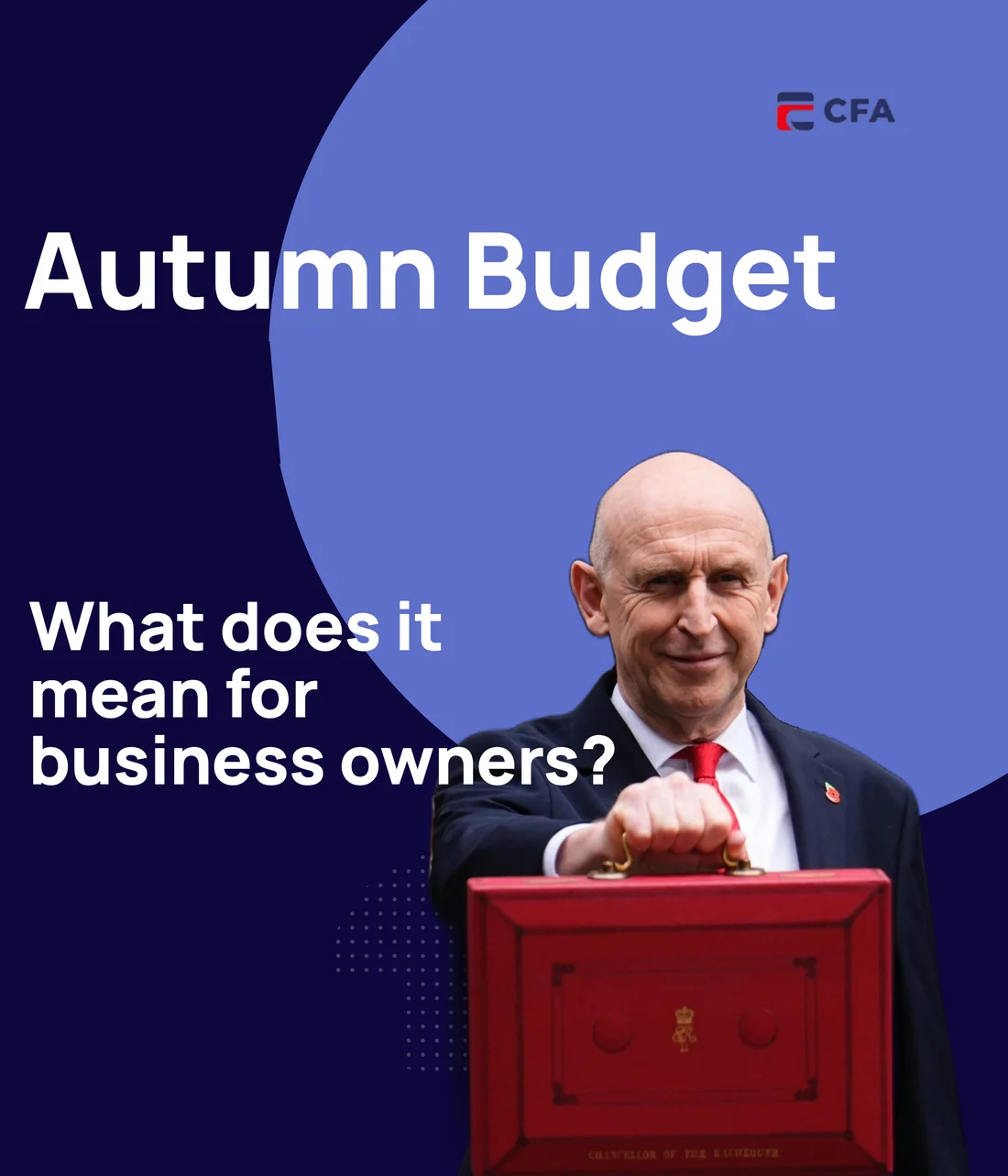
Autumn Budget 2026: What It Means for Business Owners, Landlords and Individuals
Chancellor John Healey delivered the Autumn Budget on 28 October 2026. It brings changes to capital allowances, Business Asset Disposal Relief, the Trading Allowance and the tax on property and savings income. It also introduces new incentives for founders and employee share schemes.
Most of the measures start from April 2027, so there is time to plan. Below is our summary of what has changed and what it could mean for you.
Autumn Budget 2026 at a glance
| Measure | What changes | Starts |
|---|---|---|
| Capital allowances | Main-rate first-year allowance up from 40% to 50%; main-rate writing-down allowance down from 14% to 12% | FYA: spend from 1 Jan 2027. WDA: 1 Apr 2027 (Corporation Tax), 6 Apr 2027 (Income Tax) |
| Business Asset Disposal Relief | Lifetime limit halved from £1 million to £500,000 (rate stays 18%) | Disposals from 6 Apr 2027 |
| Founders’ Relief (proposed) | 10% CGT rate on up to £10 million of lifetime gains for qualifying founders | Disposals from 6 Apr 2027 (in consultation) |
| Trading Allowance | Rises from £1,000 to £3,000 | 6 Apr 2027 |
| Property and savings income tax | Up a further 2 points to 24% / 44% / 49% | 6 Apr 2027 |
| Cash ISA allowance | Planned cut reversed: stays at £20,000 | 6 Apr 2027 |
| Employee share schemes | CSOP renamed EMI2; individual limit doubles to £120,000 | 6 Apr 2027 |
| National Minimum / Living Wage | Both up 3.9% | April 2027 |
| Mileage above 10,000 miles | Rises from 25p to 35p per mile (55p rate for first 10,000 miles unchanged) | 6 Apr 2027 |
| Business rates relief (England) | Higher thresholds for retail, hospitality and leisure | April 2027 to 31 Mar 2029 |
| Self Assessment payments on account | Move to smaller, more regular payments | April 2029 |
| State Pension | Full new State Pension rises to £13,036.40; temporary Pension Tax Allowance | April 2027 |
1. Corporation Tax and capital allowances
The main rate of Corporation Tax stays at 25%, and full expensing for qualifying companies continues unchanged. There are two changes to capital allowances:
- First-year allowance up to 50%. For qualifying main-rate expenditure incurred on or after 1 January 2027, the first-year allowance rises from 40% to 50%. This is most useful for unincorporated businesses and leasing businesses that cannot use full expensing.
- Writing-down allowance down to 12%. The main-rate writing-down allowance falls from 14% to 12%, from 1 April 2027 for Corporation Tax and 6 April 2027 for Income Tax. It was already reduced to 14% from April 2026.
2. Business Asset Disposal Relief: lifetime limit halved to £500,000
Business Asset Disposal Relief (BADR) reduces the Capital Gains Tax on qualifying disposals of a business or shares in a trading company. For disposals made on or after 6 April 2027, the lifetime limit falls from £1 million to £500,000. The BADR rate stays at 18%.
At the new limit, the most anyone can save through BADR over their lifetime is £30,000 compared with the standard 24% CGT rate.
3. New Founders’ Relief for high-growth companies
A new Founders’ Relief is proposed for qualifying share disposals from 6 April 2027. It would give a 10% Capital Gains Tax rate on up to £10 million of lifetime gains.
The relief is aimed at founders of high-growth, innovative companies, not owner-managed businesses in general. Under the current proposals, the individual must:
- have held at least 25% of the company’s ordinary shares when it started trading
- have held the shares for at least five tax years
- have been UK resident for at least five continuous tax years before the sale
The company must also meet trading and UK presence conditions and pass growth tests. The rules are out for technical consultation and may change.
4. Trading Allowance triples to £3,000
From 6 April 2027, the Trading Allowance rises from £1,000 to £3,000. The reporting threshold for trading income under Self Assessment is also due to rise to £3,000.
The allowance is an alternative to claiming actual expenses, so it will not suit everyone. If your costs are higher than £3,000, claiming expenses will usually be better.
5. Higher Income Tax on property and savings income
From 6 April 2027, Income Tax on property income and savings income rises by a further two percentage points, to:
- Basic rate: 24%
- Higher rate: 44%
- Additional rate: 49%
These rates apply only to property and savings income. Rates on employment and trading income are unchanged.
The Personal Savings Allowance still applies: £1,000 for basic-rate taxpayers, £500 for higher-rate taxpayers and nil for additional-rate taxpayers.
6. Cash ISA allowance stays at £20,000
The planned cut to the Cash ISA allowance has been reversed, and the annual ISA limit remains £20,000 from 6 April 2027. The Government also plans a new ISA incentive for people investing in a Stocks and Shares ISA for the first time. Details are still to come.
7. Employee share schemes: CSOP renamed EMI2
The Company Share Option Plan (CSOP) is being renamed Enterprise Management Incentives 2 (EMI2). It keeps the CSOP name in legislation, so this is the same scheme with improved terms, not a new scheme replacing it. From 6 April 2027:
- The individual option limit doubles from £60,000 to £120,000.
- The interaction with the EMI limit is removed, so employees can hold options under both schemes up to their separate limits.
- The exercise period extends from 10 to 15 years.
- The window to exercise EMI options after a disqualifying event extends from 90 to 180 days.
8. National Minimum Wage and National Living Wage up 3.9%
The National Minimum Wage and National Living Wage will both rise by 3.9% from April 2027.
Employers should check the rate for every employee. That includes checking how overtime, deductions and salary sacrifice affect minimum-wage compliance.
9. Mileage rate rises above 10,000 miles
From 6 April 2027, the approved mileage rate for business journeys above 10,000 miles in your own car or van rises from 25p to 35p per mile. The 55p rate for the first 10,000 miles is unchanged.
Keep a proper mileage log and separate business journeys from ordinary commuting. For the current rules, see our guide to the HMRC mileage rate increase.
10. Business rates support for retail, hospitality and leisure (England)
From April 2027, for qualifying retail, hospitality and leisure properties only:
- 100% Small Business Rates Relief applies up to a rateable value of £18,000 (previously £12,000).
- Tapered relief applies up to £21,000 (previously £15,000).
These higher thresholds run until 31 March 2029.
Eligible pubs, social clubs and most live music venues will see their relief rise from 15% to 35% for 2027/28 and 2028/29. Bills for eligible retail, hospitality and leisure properties will also be held in real terms for those two years.
11. Self Assessment payments on account to change from April 2029
From April 2029, people who make payments on account will make smaller, more regular payments during the tax year, bringing payment closer to when income is earned.
12. Household support and the State Pension
Energy. The 0% VAT rate on household electricity has been extended until July 2027. Households in Council Tax bands A to D in England will receive a one-off £100 payment from January 2027. Gas standing charges are to be removed by the end of 2027 or as soon as possible after that. Those costs move into unit rates, though, so not every household will save the full standing-charge amount.
State Pension. The full new State Pension rises to £13,036.40 a year from April 2027, which is above the £12,570 Personal Allowance.
A temporary Pension Tax Allowance will apply from 6 April 2027 to 5 April 2030. Under it, pensioners whose total income is no more than the full new State Pension pay no Income Tax. The allowance is withdrawn by £1 for every £3 of income above that level.
The Government will also adjust the Triple Lock from the next Parliament, so that over time the State Pension tracks earnings.
What should you do next?
You do not need to change everything now, but it is worth reviewing your position before April 2027:
- Review your tax position for Corporation Tax, personal tax, rental income and savings.
- Time major purchases with the new capital allowance rules in mind.
- Revisit your exit plans if you expect to sell your business, and watch the Founders’ Relief consultation.
- Update your cash-flow forecast for higher wages and changes to tax payment dates.
- Check your records and payroll are ready for the new rates.
Several measures still need legislation or further guidance, so some details may change.
How CFA Accountants can help
We work with company directors, the self-employed, landlords, start-ups and growing businesses across Manchester and Salford. We can help with:
- Company accounts and Corporation Tax
- Self Assessment and personal tax
- Bookkeeping and management accounts
- Payroll and pension administration
- VAT and Making Tax Digital
- Cash-flow forecasting and business planning
If you want to know how the Budget affects you, get in touch and we will go through it with you.
Tell us about your business, property or investments and we will explain what the Autumn Budget changes mean for you, and what to do before April 2027.
Source: HM Treasury, Budget 2026 (GOV.UK)
This article is for general information only and reflects the Autumn Budget 2026 announcements as at 29 October 2026. Some measures are subject to legislation, consultation or further guidance. Tax treatment depends on individual circumstances. Please take advice before making financial, investment or business disposal decisions.
CFA Assistant
Here to help